Thursday, March 7, 2013

Engines: The VQ.

This one is the front runner in my book as of right now. That might change, but right now this is where my head is at.

This is the VQ35DE/HR.


This is a very special engine. The basic numbers are pretty awesome.

  • 285-315hp depending on engine version.
  • 6800-7500rpm redline depending on version.
  • Compact 6 speed gear box
  • Dressed weight of about 450lbs, almost the same as an L26.
  • 3.5l of displacement.
It's a V6, so it's incredibly short. Look at how much of it is behind the shock towers.


So why this V6 instead of the Turbo monsters we've seen this week? Lets start with availability. Every 350z and G35 has one of these engines. Every Maxima, Murano, FX35, M35 has one. This engine has been the only V6 that Nissan/Infiniti has been using for the last 10 years. That means parts are cheap and easy to find.

Power. A late model VQ with aftermarket exhaust and camshafts can lay down 320-350 horsepower. At the wheels. In a 3300 350z that's a lot of power. In a 2200 Datsun, it's reckless.

Price. The engine itself and transmission can be had for $2000-2500 and with them being made in such large numbers, there will always be replacements easy to find. A current eBay search turned up over 300 motors ready to ship.

Ease of installing. With no turbo to account for, there's less to figure out. Just give it air, fuel, coolant and oil and it will run forever.

If we ever want insane power, an aftermarket turbo or supercharger kit is available. Rebuilding these motors for big power is pretty easy.

Con's? A couple.

Can't run A/C. The A/C compressor occupy's the same space as the steering shaft.

It's loud. A VQ in a 350z has two exhaust manifolds, two catalytic converters, two resonators and two mufflers and you can still hear it for miles when it's under full load. The good news is the sound is amazing.


Wiring. Because of high theft rates, this car uses a very intricate security system. The Engine Control Unit, Body Control Unit, Wiring Harnesses, accelerator pedal, ignition switch and key all have a random number generator that are sequenced together. That means all of those components have to come from the same car and they all have to be wired in to our Z.

Our, we pay almost a thousand dollars and have the ECU modified to have all the security stuff removed. Then it will run in any chassis, or on the ground.

So in order to do a VQ swap, we would need to do one of two things. Buy and engine and transmission on eBay and try to source all the wiring and control modules from a auto wrecker that is tearing down a 350z.

Or we buy a wrecked 350z and we pull everything ourselves. Crashed 350z's can be had for about $4000. This would actually be a good option for us. We can swap over the 350z seats and the rear differential as well. Then we sell as much of the brakes, suspension and not damaged body panels and scrap the rest to recoup our costs.

--

So what engine are we going to use? There's a lot of options and we've got plenty of time to think about it. Next week we talk about what a fuel injected swap entails in an older chassis.

Wednesday, March 6, 2013

Engines: Nissan Inline 6's

So, Datsun becomes Nissan. Makes sense to put a Nissan engine in our Datsun. If we want to stay in the same family, then our logical choice is the Nissan RB-series. Lets start with the monster.

The RB26DETT.


This. This is the engine that got the Nissan Skyline GT-R banned from Australian motorsport. The RB26 started as a Group A series race car engine. In order to compete Nissan had to sell this engine in normal cars. In order to follow under the rules production engine's had to be the same as race car engines. 2.6l, Dual overhead camshafts with variable valve timing on the intake side. The best way to describe this engine - If the race car is all the dials turned to 10, the street car was the same hardware dialed down to 7. Japan had this funny bit in the 90's where no one would make a car with more than a claimed 276hp, so that's how much it said on the window sticker. Car owners would go on to dyno their cars and see more like 320-330hp. Two turbo's no waiting. Want insane power? Slap a single big turbo and turn those dials back up to 10 with some basic software changes. The engine can handle 600hp without any internal changes.

So why not? Seems like the best spiritual successor right? It is. But there's always a few problems.

In order to domintate on the track GT-R's are all wheel drive. The front driveshaft and front differential are built into the lower oil pan. That means the oil pan has to be converted over to a non-AWD RB oil pan. Also, the factory 6 speed cannot be used. The 5-speed from a non-AWD Skyline is needed.

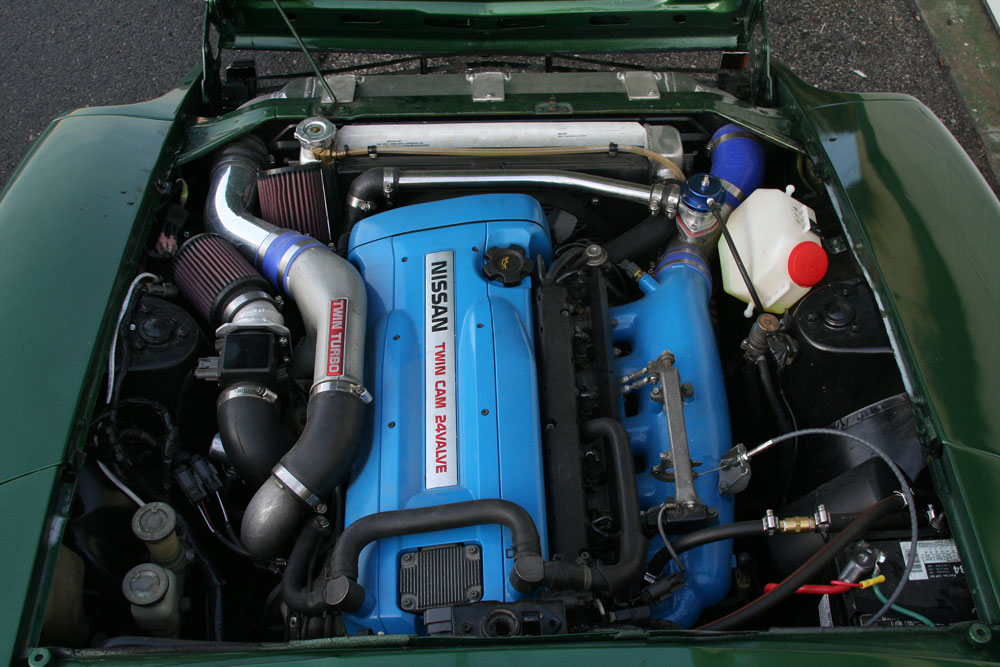
Heat and weight. Much like the 1JZ-GTE from yesterday Twin Turbos mean more heat. Look at the turbo side (The pipe that says Turbo). There's barely any room over there.

Cost is the big one though. A RB26DETT motor fully dressed from eBay is anywhere betwen $3000-4000. Add in the custom oil pan and transmission and your looking at $5000-5500 to setup a RB26 for Datsun use.

So what do we do if we can't have an RB26? We look at it's little brother who is just as smart, but not quite as ambitious, the RB25DET.


The RB25DET is in the same family, but it's a 2.5l and only has one turbo. 250ish horsepower out of the box. Came in rear wheel drive from the factory so no conversion needed. As you can see, it fit's just fine. Single turbo is easier to manage heat and plumb intercooler piping for. More power is easy to get. 400hp is only a manual boost controller and some fuel injectors away. An RB25DET could be sourced with transmission for $2000-3000.

This would keep us in the Nissan family tree. The RB-series is quite literally the next version on the L-series we started with. They've been in production from 1989 to 2002 so there's plenty of them. Despite never being sold in America they were sold everywhere else so spares are easy to get. In fact, this engine swap is so popular in the 240sx community that there are dozens of USA based sources for parts.

It's hard not to choose an RB, but I think I have an engine in mind that is literally perfect. That will be the last engine post, and it's so good it's getting a whole post to itself.

Engines: Toyota.

If we don't think a four cylinder is the right fit, then maybe we need something with 6 cylinders.

Toyota makes two engines that fit that bill. Lets start with the Non-turbo 2JZ-GE.


Here's the motor in it's natural home, the Lexus SC300. I'm starting here because we need to point out something. That giant pipe over the hood. We'll see that a couple of times this week.

So lets talk spec's.


  • 220hp.
  • Weighs about 450lbs.
  • 3.0l displacement.
  • Cross flow head with 4 valves per cylinder.
We would need to make some changes to the motor for our engine bay.


Aftermarket exhaust manifold and a new intake manifold setup would put us at about 250-275 horsepower. No turbo means INSTANT throttle response  Not quite 300 horsepower, but still very respectable  More importantly, it fit's the spirit of the car. Silky smooth power and enough grunt to force our lightweight chassis to fly.

Also, if we ever decide to add a turbo, this block and head can support 500-600hp without any internal modifications. A factory based turbo kit can be fashioned for under $1000.

So the other motor?

The Toyota 1JZ-GTE.


Let's break that name down.
"JZ" - Engine family. Same as the 2JZ so there's some interchangeable parts.
"G" - Performance tuned Cylinder head. (Rumored to be designed by Yamaha.)
"T" - Turbo. In this case, Twin Turbo.
"E" - Electronic Fuel Injection.

Specifications

  • 280hp. Although with the custom intake and exhaust piping, more like 300hp.
  • 475lbs fully dressed with turbo's and accessories.
  • 2.5l

How's it look in a 260z?


There's some problems with either JZ motor.

Their usually "front sump" oil pans. That means there's a big hump in the oil pan under the front of the engine. They would need to be converted to rear sump systems.

Transmission. The 2JZ-GE can use a Toyota W58 transmission that easy to get, and the 1JZ can use a R154, again easy to get. However if we go 1JZ, that R154 needs a $400 bell housing to mate the transmission to the block.

Cooling. The 1JZ would have a very complicated turbo and exhaust system. Two turbos means twice the heat.

Cost. Their not cheap. Given the conversion work that needs to be done to adapt them to our Datsun, the 2JZ is going to be $1300-1700 and the 1JZ will be between $1800-2500 with transmissions.

The good news is if we went with the 1JZ-GTE we can install it and make it run in as close to stock as possible and have a monster of a car.

The 1JZ-GTE is very high on my list of possible choices.

Tomorrow, lets talk Nissan Inline 6 motors.

Tuesday, March 5, 2013

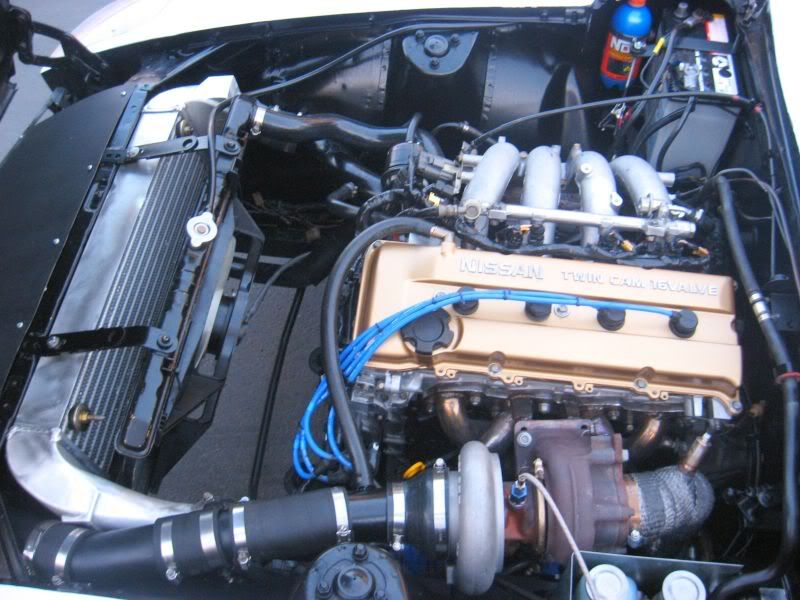
Engines: Four Cylinders.

So because engine design has advanced so much in the last 40 years, there's a couple of Nissan four cylinder engines that we should look at.

The first is the KA24DE from the 92-98 240sx and the front wheel drive Altima.

Out of the box it's not that special of an engine. 2.4l of displacement. 165hp. Dual Over Head Camshaft design with a cross flow head (Intake and exhaust manifolds are on opposite sides of the head).

The real magic in this motor comes from building your own turbo system for it. Then you get this.


This is now a KA-T. As you can see almost all the engine weight is behind the strut tower. With proper tuning this engine is anywhere between 200-350whp depending on setup. There's no firm number because this is not a factory Nissan motor. Every KA-T is hand made so the quality and tuning are very inconsistent.

Positives

  • Weighs almost the same as the original L26 and the weight is centered towards the rear of the engine bay helping balance and handling.
  • No timing belt, uses a chain so lower maintence costs.
  • Cheap. The base KA24DE motor can be found with a transmission for under $500. The turbo hardware can be put together for $500-1000. 
  • Uses the same engine mounts as the other Nissan four cylinder.
  • 2.4l means an insane amount of low end torque. The reason why this motor works so well is the low end torque pulls you off the line and when the torque wave ends the turbo boost kicks in. Think a surfer on a wave. The torque is the wave, when the surfer hits the water, he fires a jet pack.
  • Cast iron block and head mean that if we want real high boost, upgraded crankshaft, connecting rods and pistons are all that's needed to reinforce the block.


Downsides? Well a few. First, since the KA24DE was not a factory turbocharged engine the internal engine parts aren't the strongest. They can handle low boost settings, but anything over 6-7psi and your going to need to replace the rotating assembly. Second is relying on alot of aftermarket and eBay parts for our turbo system. This is not a kit, it's get every little piece from different sources.

Let's talk about the other Nissan four cylinder. The SR20DET.

2.0l of displacement. Factory turbocharged engine. Makes between 210-250hp depending on the year. This is the equivalent of the 289ci Ford V8 in Japan. Anything you could think of doing has been done. This motor was produced from 1989 to 2005. Despite never being sold in the states, parts are still readily available for it over here. This engine is the heart of countless race cars, everything from D1 and Formula D drift cars to drag racers to countless Time Attack cars. These engines can make up to 400hp without having to be upgraded internally. 2.2l stroker kits and wise turbo choices can push it to 500-600hp.

So how does it fit in a S30 Z chassis?


Exacty like the KA-T because they use the same engine mount locations. The KA24DE and the SR20DET were both factory engine in the same car just in different countries.

So, positives.

  • Sky's the limit. Anything you want to build, just open your checkbook and order away.
  • See the notes on the KA about weight and position. Same here.
  • Since the motor was turbocharged from the factory the internals are very robust. This motor was built to take a beating and keep screaming down the road.
  • Fairly cheap. $1500-1800 for a complete running motor with transmission. That usually comes with manifolds, turbo, wiring and ECU. About 80% of everything you need to make it run.
  • We trade the low end torque for a 7000 rpm redline. 
  • Our 300hp goal is a new turbo and some better fuel injectors away.


Negatives? Not many. The big one is a problem for both motors. Is a four cylinder with a turbo an appropriate exhaust note for a 260z? More a matter of opinion. And how do these two engines stack up to our other choices?

Tomorrow we see what Toyota has to offer and we start talking 6 cylinder motors.

Monday, March 4, 2013

Engines: The unlikely choices.

So let's start our engine talks with one that I don't want, one that even I think is unrealistic and one that we can't ignore.

First, what I don't want. Let me be clear. No V8's. No Small Block Chevy. Lo LS1/LS2. Their not hard to do, but their inefficient. An LS2 uses 6.0l of displacement to get 400hp and enough torque to twist our frame. It's not a bad option for racing or if all I wanted to do was lay down tire tracks everywhere I went.


As you can see, American V8's seem right at home in our Datsun engine bay. There's a lot to like. All the engine weight is behind the front strut towers. Tons of power and torque. The problem for me is it just doesn't sound right. I mean to your ears. The 8 cylinder exhaust note out of a Datsun is just not right. Let the old Camaro and Covette guys keep their big thirsty V8's. We have better options.

You know what would be really neat? A Rotary.


So why not? Well a few reasons. Due the grenade like temper of rotary engines we would have to be very VERY careful about heat management  That means no turbo's. There's two versions of the rotary one is a 2 rotor with a turbo that clocks in at 1.3l. Small, but rotary engines are rated differently  That 1.3l with a good turbo steup can put down anywhere between 200-500 horsepower at the wheels. All while centering the weight behind the strut towers. Without it's turbos, it's hard to make good power and still be civil on the streets. That leaves us with the other option. The 3 Rotor 20b. 2.0l of displacement. Without turbos and some clever tuning it can lay down 300hp and still be light weight. It can rev to 10k RPM as well and sounds amazing. So, again why not? The 20b was never sold in America and it was mostly sold in a twin turbo set up. That means it's expensive and would have to be rebuilt for non-turbo living. It also means any time we need parts it's all special order. Not only is it a foreign motor, it's a foreign motor idea. Finding 20b tuners is tough.

This would also be a very cost-prohibitive engine. Easily a $5000-$8000 project to get running right.

So let's play a game of what if. What if......we build a period correct car for the late 80's? Our engine of choice would be another L-Series like we talked about yesterday, but with a twist. This is the L28ET.


It's a factory turbocharged L28. The "E" means "Electronic Fuel Injection" and the "T" is for "Turbocharged".

A L28ET can lay down 150-400whp with careful tuning. Physically it would bolt right in. We would need to run fuel injection hardware and wiring, but we are going to do that anyway. So why would we not use this engine? Mainly because turbocharger design and layout wasn't that great in the 80's. It's still a basic L28, so it's still only has 1 camshaft with two valves per cylinder. The two valve thing means that intake and exhaust ports are on the same side of the engine. On a non-turbo car that's okay. A turbo makes things more complicated though. The turbo is RIGHT BELOW the intake manifold and the brake master cylinder. Turbos generate a lot of heat. By using an S30 chassis, we make the engine bay a little smaller so heat management is EVEN HARDER. Also, turbo L28's sound like diesel trucks.

We can do so much better than this relic. If we already had one, I'd use it, but not worth spending $3000-$4000 to find, rebuild, plumb and modify one to fit our needs.

Tomorrow we talk Four Cylinders. Yep. Four cylinders.

Sunday, March 3, 2013

Engines: Baseline Datsun L-Series.

So before we start talking about our options for a replacement engine I thought it would be a good idea to talk about what we would normally be replacing.

The Datsun L-Series Inline 6 cylinder engine.

This would have been the factory installed engine for our car. The L-series came in three sizes. 2.4, 2.6 and 2.8 liter engines.  I'm not going to spend a lot of time talking about all the difference in the three. Since we don't have one at all, I'm going to assume we are building a fresh L motor for our specific needs.

IF we were to use a Datsun motor, then we would want to build a performance engine. Due to the interchangeable manner of Datsun engines we can pick and choose our parts.

-Engine block and head from an 81-83 Datsun 280zx. This gives us 2.8l of displacement and a good flowing head.
-Aftermarket Carburetors. Three two barrel Weber units. This gives tune-ability and a sound that is hard to describe other than glorious.
-5 speed transmission from the 81-83 280zx.


Specifications
Assuming home built L28 with aftermarket intake and exhaust.
  • 160-200hp at the flywheel depending on tuning and engine health.
  • 475lb's fully dressed
  • 2 valves per cylinder, Single Over Head Cam Shaft.


So lets break down the pro's and con's.

Pro's.
  • Direct bolt in. This is the factory motor. No custom mounts, welding, cutting or fabricating.
  • It can be made to be period correct. If your into that kind of thing.
  • Stock and maintenance parts are still pretty easy to get. 
  • People have been making 300hp L-series for the last 40 years. 3.1 and 3.2l stroker motors are fairly easy to build.
  • Used parts are easy to find.
  • The sound. The sound is insane. Listen.


Con's.
  • The L-series started as a four cylinder in the 60's. It's a 45-50 year old design. A lot has changed and improved in that time.
  • 2 valves per cylinder with one camshaft is all right, but horribly inefficient. 
  • Any motor we find will need to either be rebuilt or we roll the dice and hope it's okay.
  • Building a high output L28 is not cheap. The block and head would be cheap, but then your looking at getting the cylinder head rebuilt and modified. That carb and manifold setup is not cheap. Brand new your looking at about $1200-1400. Add another $250-300 for an exhaust header. Building this engine is a $2500-$3000 project. That doesn't include installing a transmission.
  • Due to our mostly stripped chassis there's a lot of little things that have to be done making the cost even higher. With a modern swap that stuff has to be done too, but those bits would usually come with our engine.
There's another con that is more about me than the engine. I want a modern engine. This post is more about establishing a baseline to compare our new engines too. 

The only way this engine makes any sense for us is if we can get running engine and transmission complete from air cleaner to oil pan for insanely cheap. Like sub-$500 cheap. We can put it in and drive the car, but it would only be until the new engine was ready to install.

Starting tomorrow I'm going to talk about all the engine idea's floating around my head. I need to get them all in one place because I can't make up my mind. I've got 4 great engines and one pretty good one that can't be ignored.

Saturday, March 2, 2013

First inspection: Interior (or lack thereof).

Oh boy. This is where the real work is going to be done at. Let's get started.

So we have a thick steering wheel. This looks like a factory piece. Its in terrible shape. No center button and no horn. That's okay. Period correct upgrage dictates a thick wooden steering wheel with match shift knob.


Let's check out our floors. This is a notorious problem area.

 Drivers side not too bad up front. Mostly surface rust. We'll be stripping it and coating the entire floor in POR-15 anti-rust coating after repairing the passenger side.

That wire harness dangling down most likely goes to the ignition switch which is currently missing.
The passenger side has a few holes up front. This is the other tricky problem to fix. I should be able to cut the infected section out and weld in a new piece of steel making a patch. The tan appearance that is "cracking" in these pictures is the factory noise insulation. We need to remove it to find out if we need to make anymore patches.

Those two holes in the upper left are for the factory heating system and do not need to be filled.


This might be a problem. The drivers seat bracket is damaged. The front bar has a cut up left bolt hole and that left lower bracket is flat out broken.


Better picture of our broken left rear drivers seat mount. It's torn and has been flattened on one side. I suspect with an aftermarket seat was improperly installed or a rather large person liked to throw himself into the drivers seat warping the bracket before eventually breaking it. If I can't rebend it a new one will need to be made and welded in. This might not be so bad, because aftermarket seats were always planned and you never know what needs to be done with those.

The spare tire well actually looks very nice. This is a better shot of the cracking factory noise protection.
No rust in the storage bins. We have a full size spare on the car


.
We need a new black dash cap and the interior pretty much needs everything. Most of the trim is junk or missing. The gauges are there and hopefully work. The speedometer and tachometer will need to be replaced to match the engine we're using. The radio and the speakers are gone. The good thing about having a mostly stripped interior is that I can wire it the way I want. Eventually new carpets and door panels will go in. We can put in a 4 speaker system with small subwoofer it will still look like a 70's Datsun.

That's all for now. Next week we start talking about power trains. Everyday a new engine and transmission to talk about.